Wednesday, 23 January 2013

Elaeis guineensis


Commonly known as the African Oil Palm, this palm is native to West Africa but cultivated throughout the tropics. 


The Oil Palm, an introduced species, is a medium tolarge-sized palm with a single stem covered with old leaf scars and a crown of dense foliage. The moisture, which collects on the old leaf bases of the trunk, encourages the growth of epiphytic plants and ferns on the trunk.

The flowers are monoecious, whereby male and female flowers are in separate clusters, but on same tree.

Each fruit is plum-like, ovoid and oblong in shape about 3.5 cm long and about 2 cm wide. It is yellow to black and upon ripening, turns red at the base. The flesh is thick and ivory white, with a small cavity in the center. The nuts are encased in a fibrous covering which contains the oil. They are borne in bunches and each bunch weigh about 23kg on average. A bunch contains about 200 to 2000 sessile ovoid drupes. 


Palm oil obtained for the Oil Palm is popular for use in cooking throughout the world, especially for its low price. Palm oil is used for manufacture of soaps and candles, and more recently, in manufacture of margarine and cooking fats. Palm oil used extensively in tin plate industry, protecting cleaned iron surfaces before the tin is applied. Oil also used as lubricant, in textile and rubber industries. Apart from the oil,  the central shoot or cabbage is edible too. Leaves used for thatching; petioles and rachices for fencing and for protecting the tops of retid walls. Refuse after stripping the bunches used for mulching and manuring;, while the ash sometimes used in soap-making.

Dillenia suffruticosa

More commonly known as Simpoh Air, this shrubby tree is native to Southeast Asia. 

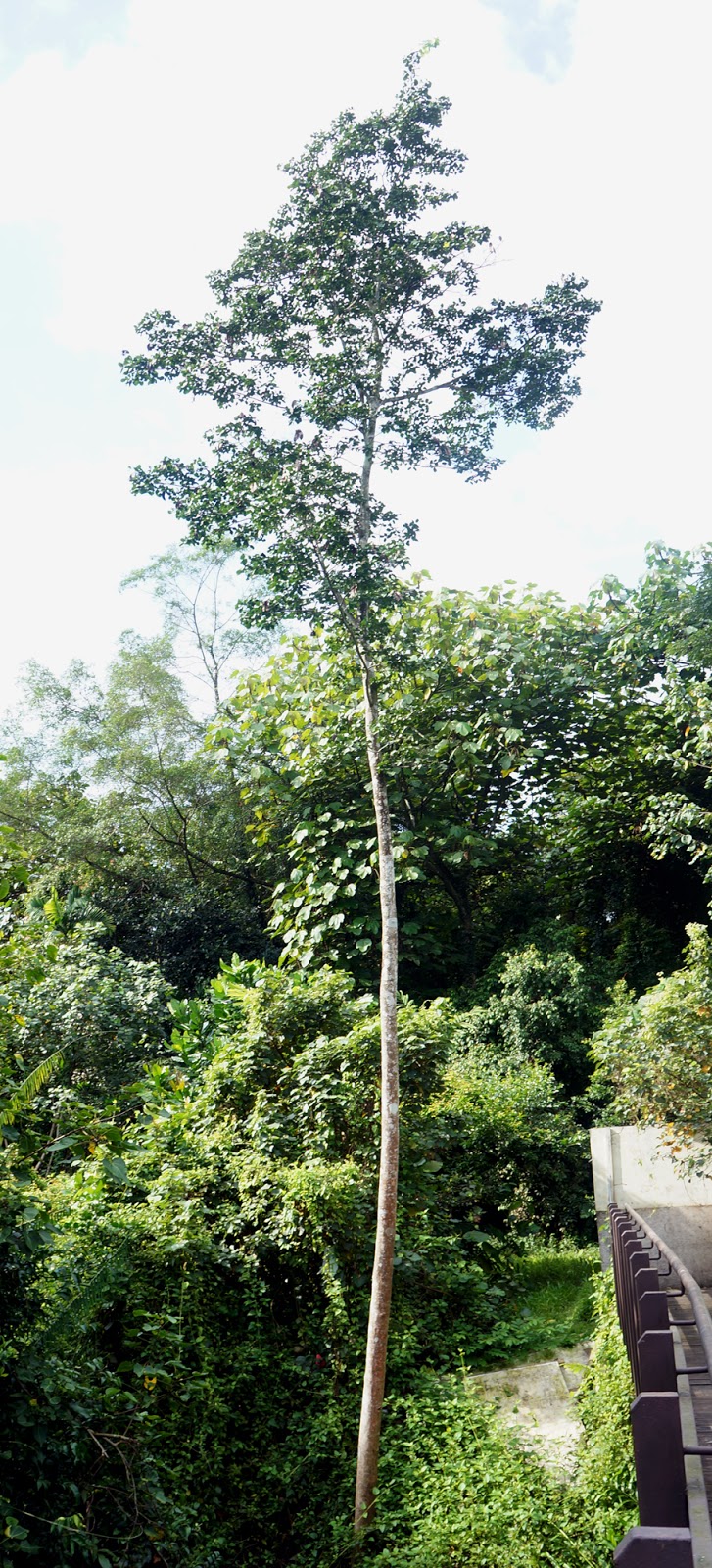
Simpoh Air is a large shrub or small tree that grows to about 6 to 7m tall. It has deep taproots to tap deep underground for water sources. As such, it is believed that their presence suggest an available water source underground. 

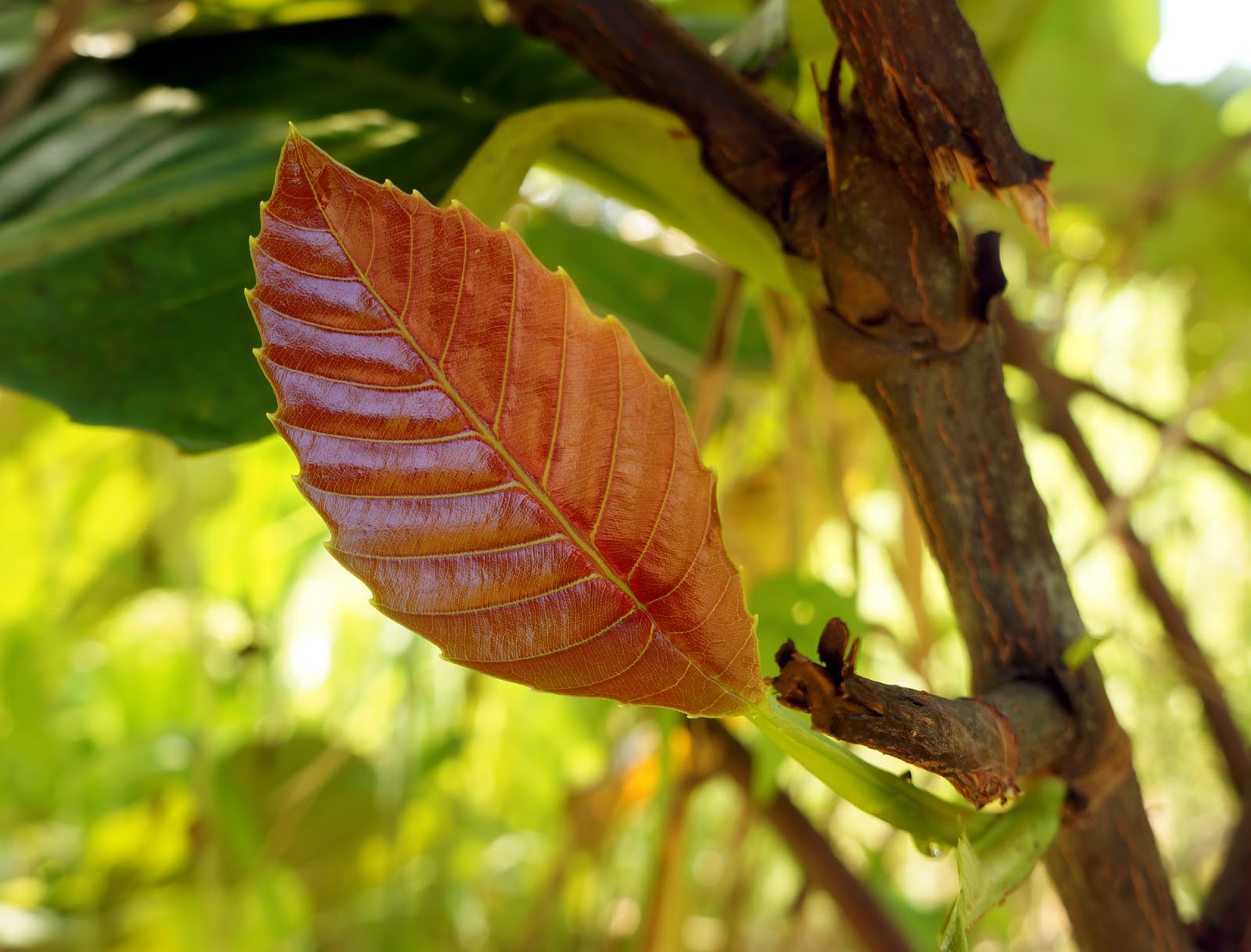
The oval leaves are large at about 15 to 35cm and with a toothed edge and fold near the stalk. The young leaves are reddish in colour and appear to have a corrugated texture. 


The large flowers of Simpoh Air are about 8 to 10cm and bright yellow in colour. The flowers have five large thin petals and grows in clusters on a long stalk, though they only open one at a time. The bud will first swell and turn yellow in the morning before the day it blooms. At about 3am the next day, the flower will start to open and become fully bloomed about an hour before sunrise. By 4pm, the petals will drop off and the sepals will fold back on the young fruit in the evening. The flower stalk will rotate slowly to point upwards when it starts to fruit after the flower blooms. The flower buds face downwards while the young fruits face upwards. 


The flowers do not produce any nectar and have no scent. Its flowers are pollinated by the carpenter bee (Xylocopa sp.) as well as small beetles and flies that are observed.

The fruits take exactly five weeks to set and opens at 3am. The pink fruit capsule resembles a star shape  when fully expanded, with 7 to 8 cells showing purple seeds that have a fleshy bright red aril. Birds and even monkeys feed on these fruits. The seeds are swallowed whole together the fleshy aril around them, and thus dispersed by the birds.The empty husk falls off at about 8am the following day.


Simpoh Air provides food and shelter for other plants and creatures, such as the Yellow-vented bulbul and is among the few plants that can germinate and grow on white sands. As a pioneer species, it provides shade for other less hardy plants to establish themselves. Its young shoots and leaves are also edible.

The large leaves are also used to wrap food such as tempeh (Malay fermented soyabean cakes), or formed into shallow cones to contain traditional ‘fast food’ such as rojak. 

Syzygium lineatum

Commonly known as the Common Kelat, this tree is native to IndoChina, Peninsula Malaysia, Singapore, Borneo, and Sumatra. 


A fruit tree of the Syzygium species, the Common Kelat is usually found in secondary forests. It grows up to about 30m tall. This tree is often conical to hemispherical in shapewith a dense light green crown. 

The faintly fragrant flowers are whitish pink or pale green in colour with protruding stamens. They  are pollinated by flies, beetles, butterflies and bees. 

The fleshy berries are about 1cm in diameter and change from green to yellow to white to reddish colour upon ripening. 

The Common Kelat can tolerate soggy, muddy conditions. Notice the tree’s conspicuous stilt roots which seem to suggest that they were once submerged in a frequently flooded environment.


May be confused with the shorter Syzygium zeylanicum, but the latter can be differentiated by its smaller, dark glossy green mature leaves with less crowded secondary veins and less distinct marginal vein, purplish-red young leaves, smaller white fruits (5 -7mm across), and reddish-brown peeling trunk. 

Hardy plant, tolerates poor sandy and limestone soils, waterlogged areas and salt-spray. Propagate by seeds, stem cuttings or air-layering. 

Tuesday, 22 January 2013

Cerbera odollam

Commonly known as Pong-Pong, it is native to India and some parts of South East Asia.


Around 10 to 15m tall, the Pong-pong is a small to medium-sized tree with greyish bark and conspicuous leaf scars. Sap is produced when plant parts are broken. The oval leaves are dark green and glossy, in a whorled arrangement at the ends of thick branches.

The white, tissue-like flowers are yellow in the middle and have a fragrant smell. They appear at the tips of the branches. 


The single fruits are oval with a smooth green skin, resembling mangoes when they are young. They are about 5 to 10cm in diameter. The outer covering is hard and fibrous to enable it to stay afloat in water. When ripening, the fruits turn from green to pink to then black. 

Each fruit contains one seed. The seeds of the Pong-Pong are extremely poisonous, containing a toxin called cerberin which causes cardiac arrest. 

They have been used for murder or suicide in India, hence its sinister common name, Indian Suicide Tree, as well as in ordeal trials in Madagascar to 'prove' one's innocence.

Seeds have been used as bio-pesticide, insect repellent and rat poison. Bark, leaves and seed oil are used in traditional folk medicine. 

Thespesia populnea

Also known as Portia Tree, this tree can be found throughout the world in tropical regions including Singapore.


The Portia Tree is an evergreen small tree around 6 to 10m tall with a short, straight or crooked trunk. It has a dense crown that is overcrowded with lower horizontal branches. 

The leaves are alternate, glossy green on the upper side and pale green on the under side. They are heart-shaped and broad with long leaf stalks. The leaves on the lower crown turn yellow before falling to the ground.


The pale yellow flowers are bell-shaped, resembling a hibiscus. The petals are yellow with a maroon spot at the base of each petal. The flowers open and close in the same day, and the colour of the flower will change from yellow to dark red, purple, or pink as the day goes by. Its flowers are pollinated by insects. The thespesia fire bug (Dysdercus simon) can usually be found associated with the leaves of this plant. 


The fruits are dry, papery, or woody capsules that contain several seeds in five cells. They grow in clusters at the ends of branches. The 1cm seeds are brown and hairy and dispersed by wind and water. 


The leaves and flower buds are edible and may be eaten raw or cooked.

The wood of this tree is prized for making bowls in the Hawaiian islands. Fiber from its bark is used to make cordage and to caulk boat. The plant is harvested for its light timber that can be made into paddles, furniture, and parts of carts.

The tree is considered sacred in the Pacific, hence is planted around temple, and its leaves are used in religious ceremony.

Intsia bijuga

Commonly known as Ipil-ipil, this tree is native to Australia, Cambodia, Indonesia, Madagascar, Malaysia, Myanmar, Papua New Guinea, Solomon Islands, Thailand, and Vietnam.

Ipil-ipil is a medium sized tree with a spreading crown that grows to about 35m in height. Mature trees have rounded and steep buttresses that can exceed 4m when fully developed. The bark is a distinctive light pinkish to reddish brown to light grey colour, generally smooth but peeling in irregular sizes exposing the fresh colour underneath.


The leaves are smooth, shiny, and light green in colour. They are pinnately compound, with about four leaflets in a broad, elliptical shape. 

Individual flowers are moderately large with four green sepals. The petals are white with a red center. The flowers flower all year round. 

The fruits are in the form of thick, oblong, and rigid pods up to 10cm wide and 30cm long. Each pod contains two to eight round seeds which are brown in colour and flattened. The fruits have a laxative effect though the seeds can be consumed.

Pipturus argenteus

Commonly known as the Australian Mulberry Tree, this tree is native to Australia and can be found in forests.


The Australian Mulberry Tree is a shrubby, small-sized tree that grows to about 8m. The bark is smooth, grey in colour, and lenticellate. The inner park of the tree is soft and ranges from pale yellow to green. 

The ovate leaves are simple and alternate, around 8 to 13cm long. It has a fine toothed margin. The leaf is mid green to dark green while the underside of the leaf is whitish or silverishwith hairs.  It has pink coloured petioles.


The inconspicuous flowers that grow in clusters are cream, white, or green. The flowers are dioecious, meaning that male and female flowers are found on different plants. 

The fruits are fleshy and white to brown, resembling a mulberry. They grow up to about 6mm only. The fruit is actually a achene, clustered at the nodes to form a globose multiple fruit. It is similar to a strawberry, whereby the seeds develop on the outside.